

AI Business Assessment
AI Business Assessment: How to Find Your First Practical AI Opportunity
An AI business assessment should help you make one practical decision: where AI belongs first in your business. Not everywhere. Not in theory. One workflow, one bottleneck, one useful next step.
Small business owners are being told to use AI in almost every part of the company: sales, service, finance, operations, marketing, HR, admin, reporting, and management. Some of that advice is useful. Much of it is too broad to act on.
The real question is smaller and more useful: which workflow should be improved first?
An AI business assessment is meant to answer that question. It looks at the way work moves through the business today, where people lose time, which tools are already in place, and where AI could help without creating more confusion.
Start with business friction
The best AI opportunity is rarely the one that sounds most impressive. It is usually the one that removes friction from work that already happens every week.
Look for places where the business keeps paying a hidden tax:
- leads wait too long for a good follow-up
- customer requests are rewritten, forwarded, and interpreted manually
- reports are built from the same spreadsheet steps every week
- the owner answers the same internal questions again and again
- quotes, proposals, or onboarding tasks depend on scattered notes
- handoffs break because information lives in email, chat, forms, and memory
Those are not "AI problems." They are workflow problems. AI becomes useful when it can help draft, summarize, classify, route, check, or prepare part of that work for human review.
Separate tool curiosity from real opportunity
There is a big difference between "we should use AI" and "this workflow is ready for AI-assisted improvement."
A real opportunity usually has four traits:
- it happens often enough to matter
- the inputs are available and reasonably clear
- the output can be reviewed by a person
- the business impact is visible enough that people will care
If a task happens once a month, has messy inputs, and nobody agrees what good output looks like, it is probably not the first AI project. It may still be worth improving later, but it is a poor starting point.
A practical AI business assessment should be willing to say no. That is part of the value.
Map the current tools
Most SMBs already have more tools than they use well. Before recommending another one, an assessment should ask what is already there.
For example:
- CRM: where leads, customers, stages, and notes should live
- email: where requests, follow-ups, and handoffs often begin
- spreadsheets: where reporting and manual tracking often get stuck
- project management tools: where tasks should become visible
- accounting or ecommerce tools: where transaction data may support workflows
- knowledge bases and documents: where internal answers may already exist
The goal is not to connect everything. The goal is to understand whether the first workflow can use the systems the team already trusts.
Choose one first workflow
A useful assessment should not leave the owner with ten equally important ideas. That is just another kind of overwhelm.
The assessment should identify the first practical AI opportunity and explain why it ranks above the others. A good recommendation sounds specific:
"Start with inbound lead intake and follow-up. It happens frequently, sits close to revenue, uses available source data, and can keep a human approval step before any customer reply is sent."
That is much more useful than "use AI for sales."
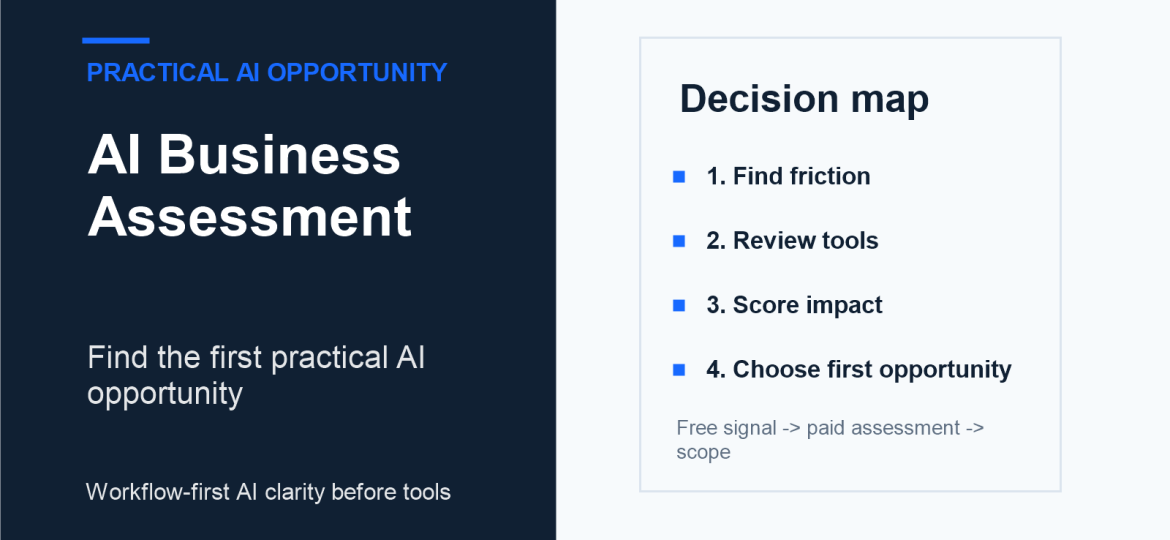
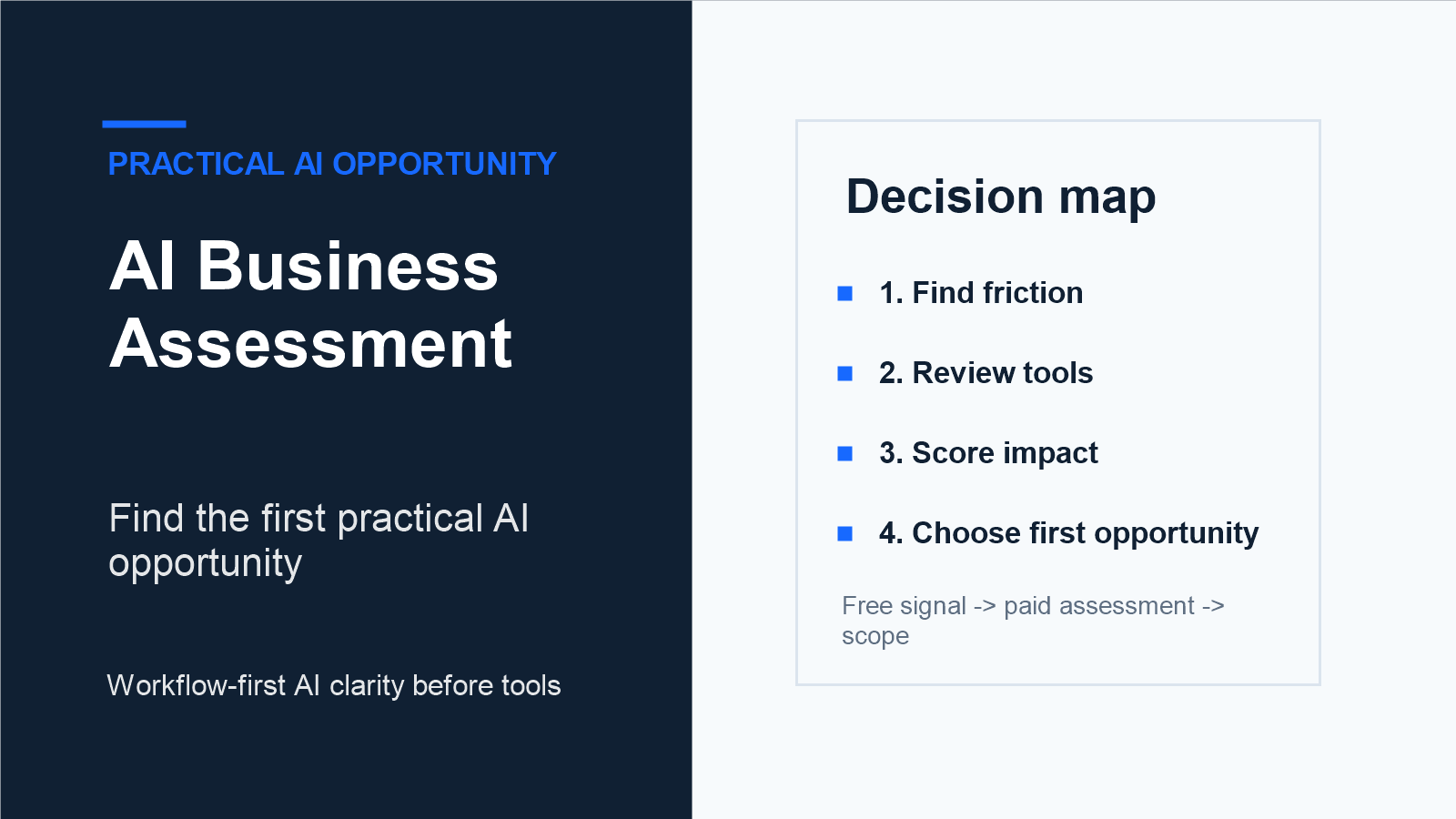
Decision rule: choose the workflow where frequency, business impact, input clarity, and human review are all strong enough for a small first version.
Define what should be built first
The first AI opportunity should become a scope, not a dream. The business should know what the first version might actually do.
Examples of practical first versions:
- summarize new leads and prepare a reviewed follow-up draft
- turn call notes into a structured handoff for the team
- classify customer requests and suggest the next owner
- prepare a weekly operations summary from known inputs
- search internal documents and draft an answer for review
Notice the pattern. AI prepares work. A person reviews it. The workflow becomes easier without handing away judgment too early.
What the assessment should deliver
At the end, an AI business assessment should give the owner a clearer view of:
- where the business loses time through repeated work
- which workflows are realistic AI opportunities
- which opportunity should be first
- what tools or data sources may be involved
- where human review should stay
- what implementation should include
- what should wait
That kind of assessment is useful even before implementation. It lets the business owner decide whether to build internally, hire help, or simply clean up the workflow before spending more money.
Free signal or full assessment?
If you are early and only want a first signal, a free assessment can help you see which area may have AI leverage.
If you already know AI matters and want a business-specific recommendation, a paid assessment is the better step. It should turn your context into a practical recommendation, not another generic list of tools.
Want the business-specific version? The AI Workflow Assessment - $797 reviews your business context, workflows, tools, bottlenecks, and first practical AI opportunity.
You can also review the sample assessment, or start with the free AI Workflow Assessment if you want a lower-friction first step.
The main point
An AI business assessment is not about proving that AI can do something. AI can do plenty. The useful question is whether it should be used in your business, in which workflow, and in what first version.
Find that first practical opportunity, and the rest of the AI conversation becomes much easier.
