

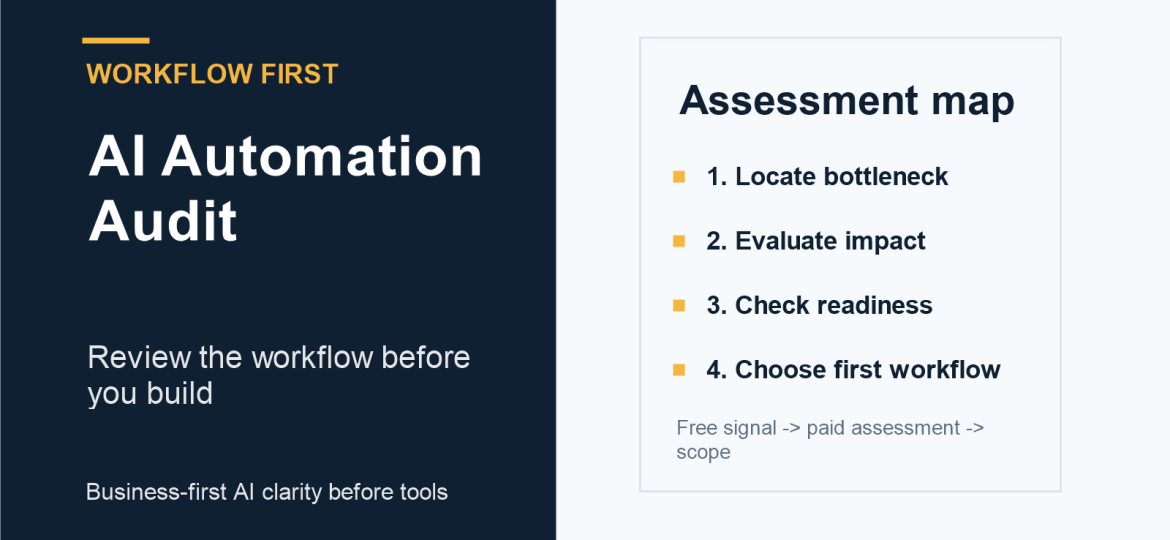
AI Automation Audit
AI Automation Audit for Small Businesses: What to Review Before You Build
An AI automation audit helps a small business slow down before it builds. The point is simple: find the workflow that deserves automation, check whether it is ready, and avoid spending money on the wrong first project.
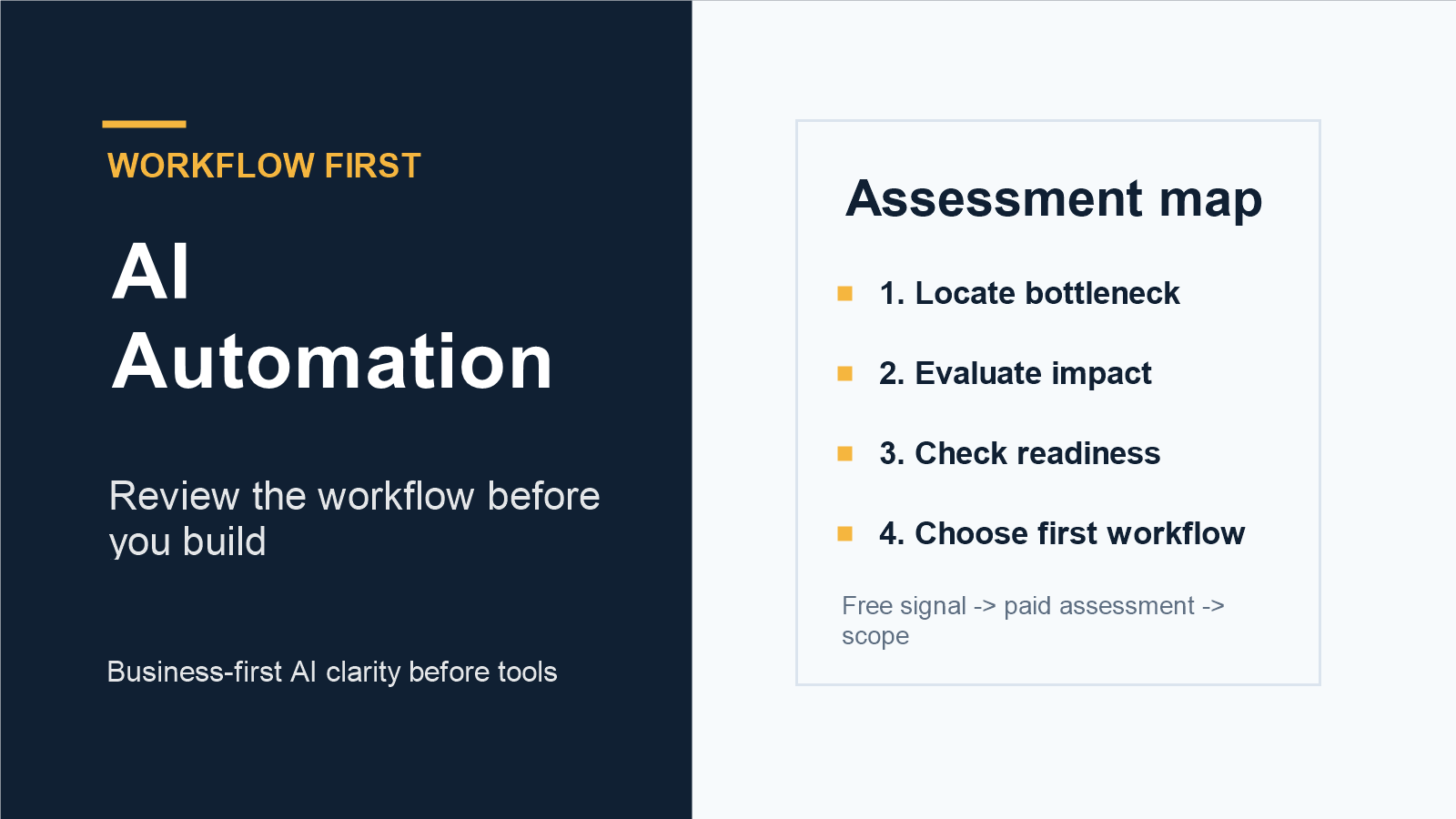
Most failed automation projects do not fail because the tool was bad. They fail because the workflow was unclear.
A team wants AI to help with lead follow-up, reporting, customer replies, invoice checks, onboarding, or internal knowledge. That is a reasonable instinct. But if nobody maps how the work happens today, the automation ends up copying the mess. It may even make the mess faster.
An AI automation audit is the step before implementation. It reviews the workflow, the data, the handoffs, the tools, the risks, and the human approval points before anyone starts building.
Start with repeated work, not tools
The first question in an AI automation audit is not "Which platform should we use?" It is "Which work repeats often enough to be worth improving?"
Good candidates usually have a few things in common:
- the task happens every week, not once a quarter
- the work has a recognizable pattern
- someone already spends time collecting, checking, drafting, routing, or summarizing information
- delays or mistakes create a visible business cost
- a person can review the output before anything important happens
Lead intake is a good example. A small business may receive inquiries through forms, email, referrals, and LinkedIn. The owner reads each one, pulls out the details, decides what matters, drafts a reply, and tries to remember the next step. That is not just admin. It sits close to revenue.
That is often a better first AI automation opportunity than a vague "AI strategy" project.
Review the current workflow
Before building anything, write down how the workflow works today. Keep it plain. You do not need a formal consulting diagram to learn something useful.
For each workflow, ask:
- What triggers the work?
- Where does the information come from?
- Who touches it first?
- What decisions are made?
- Where does the work get delayed?
- What has to be checked by a human?
- What is the final output?
- What happens next?
This review often reveals that the first fix is not AI. Sometimes the business needs a cleaner form, a better intake question, a shared inbox rule, a CRM stage, or one clear owner for the next action.
That is not a disappointment. That is the audit doing its job.
Check the data sources
AI automation depends on input quality. If the system receives vague, missing, or scattered information, the output will be weak.
In a small business, the useful data sources are often ordinary:
- website forms
- emails and shared inboxes
- CRM records
- spreadsheets
- call notes
- support tickets
- project management boards
- documents and SOPs
The audit should ask whether those sources are consistent enough to use. It should also identify what should not be shared with an AI system: passwords, confidential customer data, sensitive personal information, regulated records, or anything the business is not allowed to process that way.
Decide where human review belongs
For many SMB workflows, the safest first version is not full automation. It is assisted automation.
That means AI prepares the work, and a person approves it. AI might draft a follow-up email, summarize a call, classify a request, prepare a checklist, or suggest a next step. A human still reviews the output before it goes to a customer or changes a business record.
This is where many businesses get AI wrong. They jump straight to replacement when preparation would be more useful and easier to trust.
Practical rule: if a mistake could upset a customer, create legal risk, damage trust, or move money, keep human review in the first version.
Score impact against effort
An AI automation audit should compare opportunities. Not every annoying task should be automated first.
Useful scoring questions include:
- How often does this workflow happen?
- How much time does it consume?
- Does it affect revenue, customer experience, delivery speed, or owner dependency?
- Are the inputs clear enough?
- Can the output be reviewed easily?
- Does the team already use tools that can support the workflow?
- Would a first version be simple enough to test?
The strongest first workflow is usually high enough impact and moderate enough effort. If it is too complex, the project may stall. If it is too trivial, nobody will care.
Define the first useful version
The audit should end with scope. Not "automate sales." Not "use AI for operations." Something smaller.
Examples:
- summarize new inbound leads and prepare a draft follow-up for review
- turn weekly spreadsheet updates into a short management summary
- classify support requests and suggest the next internal owner
- prepare onboarding checklists from signed agreements
- search internal documents and draft an answer for employee review
That first version should have clear inputs, clear outputs, a human review point, and a simple success measure. For example: fewer missed follow-ups, faster response time, less manual sorting, clearer handoffs, or fewer repeated internal questions.
What to do after the audit
After an AI automation audit, the business should know one of three things:
- this workflow is ready to improve
- this workflow needs cleanup before automation
- this workflow is not the right first project
All three are useful outcomes. The worst outcome is building something just because the team feels pressure to "do AI."
Want a business-specific audit? The AI Workflow Assessment - $797 reviews your workflows, tools, bottlenecks, opportunities, effort vs impact, and recommended first workflow.
If you want proof of the format first, review the sample assessment. If you are still exploring, take the free AI Workflow Assessment.
The main point
Do the audit before the build. A small business does not need more AI activity. It needs one workflow that is clear enough, frequent enough, and valuable enough to improve.
That is where AI automation becomes practical. Not everywhere. Somewhere specific.
