


Agentic AI Is Becoming Practical: What Claude, Codex, and New AI Agents Mean for Business
Claude, Codex, and new computer-use agents are moving AI from chat into real workflows. Here is what business owners should watch before buying another tool.
Most business owners do not need another lecture about model benchmarks. They need to know whether AI can take work out of a real process: quote follow-ups, reporting, invoice checks, customer replies, internal knowledge search, or the weekly tasks that quietly consume Friday afternoons.
That is why the recent AI news around agents matters. OpenAI, Anthropic, GitHub, and Google are all moving in the same direction: AI systems that can use tools, work across longer tasks, operate software interfaces, and hand structured results back to people.
This does not mean every company should rush into a custom AI agent project. I would not start there. But it does mean the useful question has changed.
The question is no longer only, "Which chatbot should we use?" It is becoming, "Which repeated business workflow could an AI agent support, and where should a human stay in control?"

What changed in the latest AI agent news?
Several recent announcements point in the same practical direction.
OpenAI's GPT-5.4 update puts more emphasis on agentic work: long context, computer use, tool search, and stronger performance in Codex. OpenAI also introduced a GPT-5.3-Codex model focused on software engineering tasks, with better planning and tool use for longer coding work.
In parallel, OpenAI has been building out the agent platform around Codex and the Responses API. The Codex app is built around delegating work to agents in the background. The Responses API added a computer environment so agents can run code, manage files, and use controlled tools. OpenAI also announced WebSockets support for lower-latency agentic workflows.
Anthropic is moving in a similar direction with Claude. Claude Opus 4.7 is positioned around complex, long-running work, coding, tool use, and computer use. Claude Sonnet 4.6 also focuses on coding, agents, and longer context windows. For businesses, the important signal is not the model name. It is that the major AI labs are designing models to do multi-step work, not only answer prompts.
GitHub is making the same trend visible inside developer workflows. It has added models such as GPT-5.3-Codex and Claude 4.6 models into Copilot. Google has also released a Gemini Computer Use model for agents that interact with user interfaces.
Different companies, different products, same direction: AI is being pushed closer to the work surface.
The practical meaning: AI agents need a workflow, not just a prompt
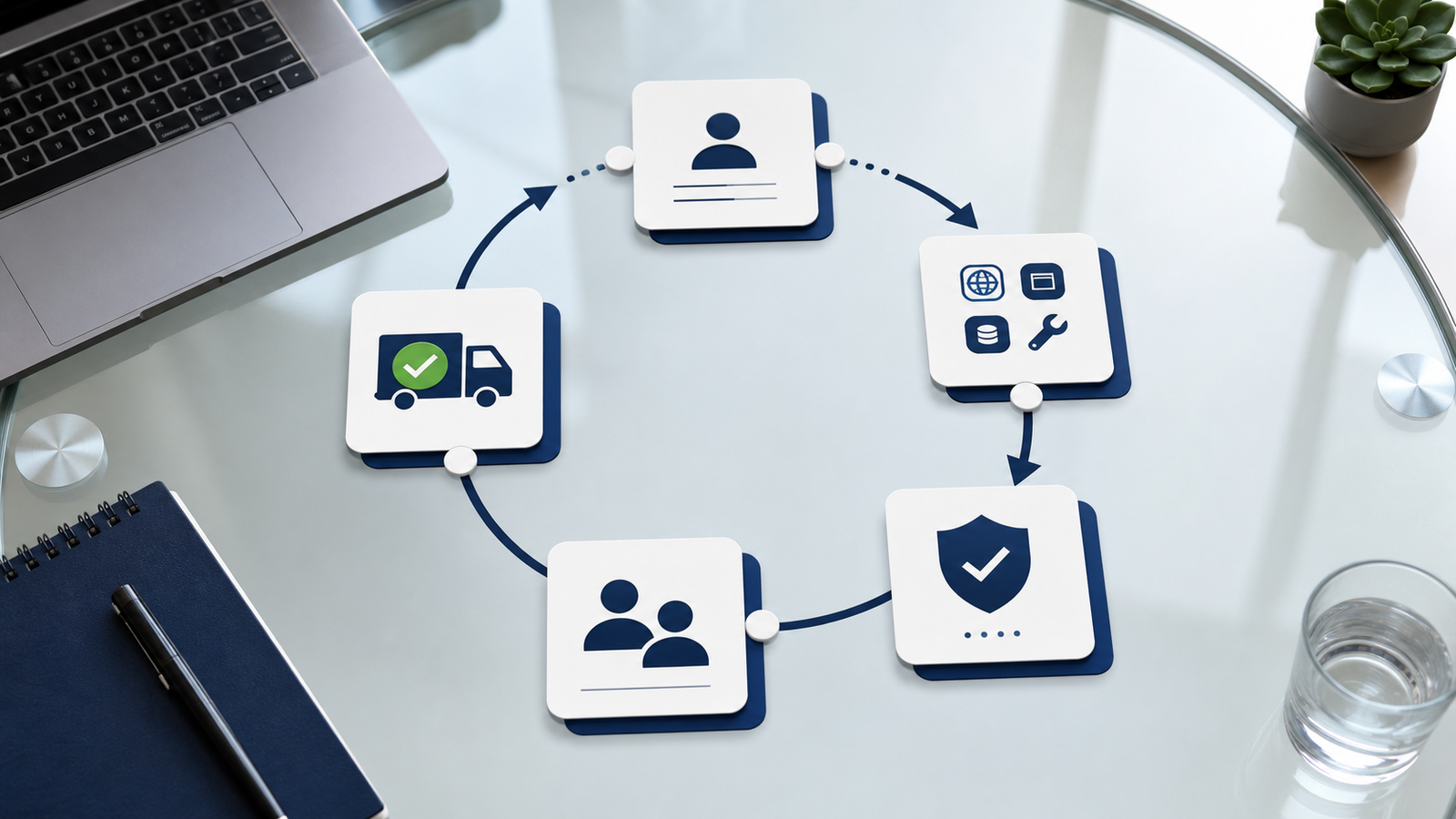
An AI agent is not automatically useful because it can click buttons or call tools. That is only capability. Business value appears when the agent has a clear job, clean inputs, permission boundaries, and a review step.
For example, "use AI in sales" is too broad. "Check new inbound leads, draft a follow-up, flag missing context, and prepare a summary for the sales owner" is much more practical.
The same is true in operations. "Automate reporting" is vague. "Collect three weekly inputs, compare them with last week's numbers, draft a short variance note, and send it to a manager for approval" is a workflow.
This is where agentic AI for business becomes interesting. It can sit between messy human work and final human judgment. It can collect, check, draft, summarize, classify, route, and prepare. But the business should still decide what gets sent, changed, approved, or promised to a customer.
Where I would look first in a real business
I would not start with the most impressive AI demo. I would start with repeated work that already has some structure.
- Customer emails that need the same kind of answer every week.
- Quote follow-ups that are easy to forget but important for revenue.
- Internal questions that always go to the same person.
- Reports copied from one system into another.
- Invoice or order checks where the rules are known but the work is manual.
- Meeting notes that need to become tasks, risks, and owner lists.
These are not glamorous use cases. That is the point. A small time leak that repeats every week is often a better AI starting point than a large transformation project nobody can explain clearly.
If a task happens often, follows recognizable rules, uses available information, and still benefits from human review, it may be a good agent candidate.
What Claude and Codex tell us about the next phase
Claude and Codex are especially useful signals because they show where agentic AI is already being tested under pressure: software development.
Coding work is not simple. It involves reading context, making changes, using tools, checking errors, and sometimes backing out of a bad direction. That is why coding agents are a useful preview for business agents. They show how AI behaves when the work has multiple steps and the answer is not just a paragraph of text.
The lesson for business owners is not "everyone needs a coding agent." The lesson is that the agent pattern is maturing: give the system a bounded task, give it tools, let it work, and make verification part of the process.
That same pattern can apply outside software: customer support triage, procurement checks, CRM cleanup, onboarding follow-ups, finance admin, internal knowledge search, and sales operations.
The risk: confusing autonomy with business readiness
There is a trap here. Because AI agents can now do more, it is tempting to give them too much freedom too early.
That is usually where businesses get disappointed. AI will not fix a broken process. It may only move the confusion faster.
Before giving an agent access to tools, answer a few boring but important questions:
- What exact task should the agent complete?
- What information is it allowed to use?
- What should it never access?
- When must a human approve the result?
- How will errors be noticed?
- What happens if the agent is unsure?
These questions are not anti-AI. They are what make AI useful in a real company.
A simple way to start
If you are a business owner, start with one workflow map. Pick one repeated task your team already complains about. Write down the input, the steps, the systems involved, the decision points, and the final output.
Then ask: where could AI prepare the work before a person reviews it?
That is usually a safer first step than asking, "Which AI agent platform should we buy?"
For many companies, the first valuable agent will not be fully autonomous. It will be an assistant that collects context, drafts a response, checks a document, summarizes a call, or prepares a report for human review.
That may sound less exciting than the headlines. It is also much closer to how businesses actually create value.
The bottom line
Recent updates from OpenAI, Anthropic, GitHub, and Google show a clear shift: AI is moving from conversation toward action. Codex, Claude, computer-use models, and agent platforms are all part of that movement.
But the useful starting point is still your business, not the model name.
Find the repeated work. Map the process. Decide where AI can prepare, check, or summarize. Keep human judgment where it matters.
That is where agentic AI starts to become practical.
Next step: If you want a practical starting point, take the Free AI Business Assessment and identify where AI could help first in your own workflows.
