

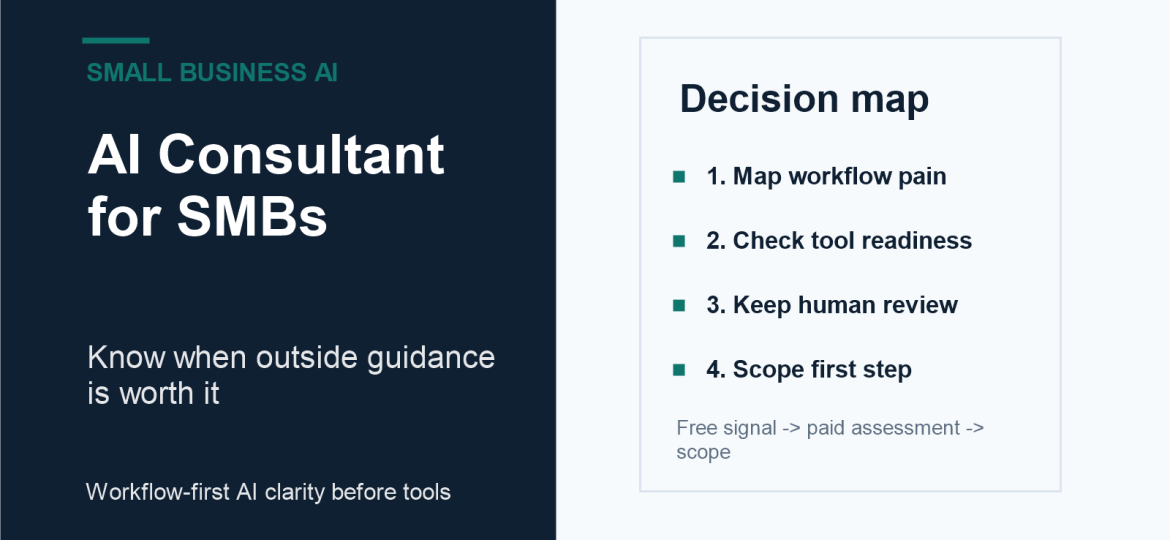
Small Business AI Consultant
AI Consultant for Small Business: When Do You Actually Need One?
A small business does not need an AI consultant just because AI is moving fast. It needs one when the owner knows there is leverage somewhere in the business, but the first practical workflow is not obvious yet.
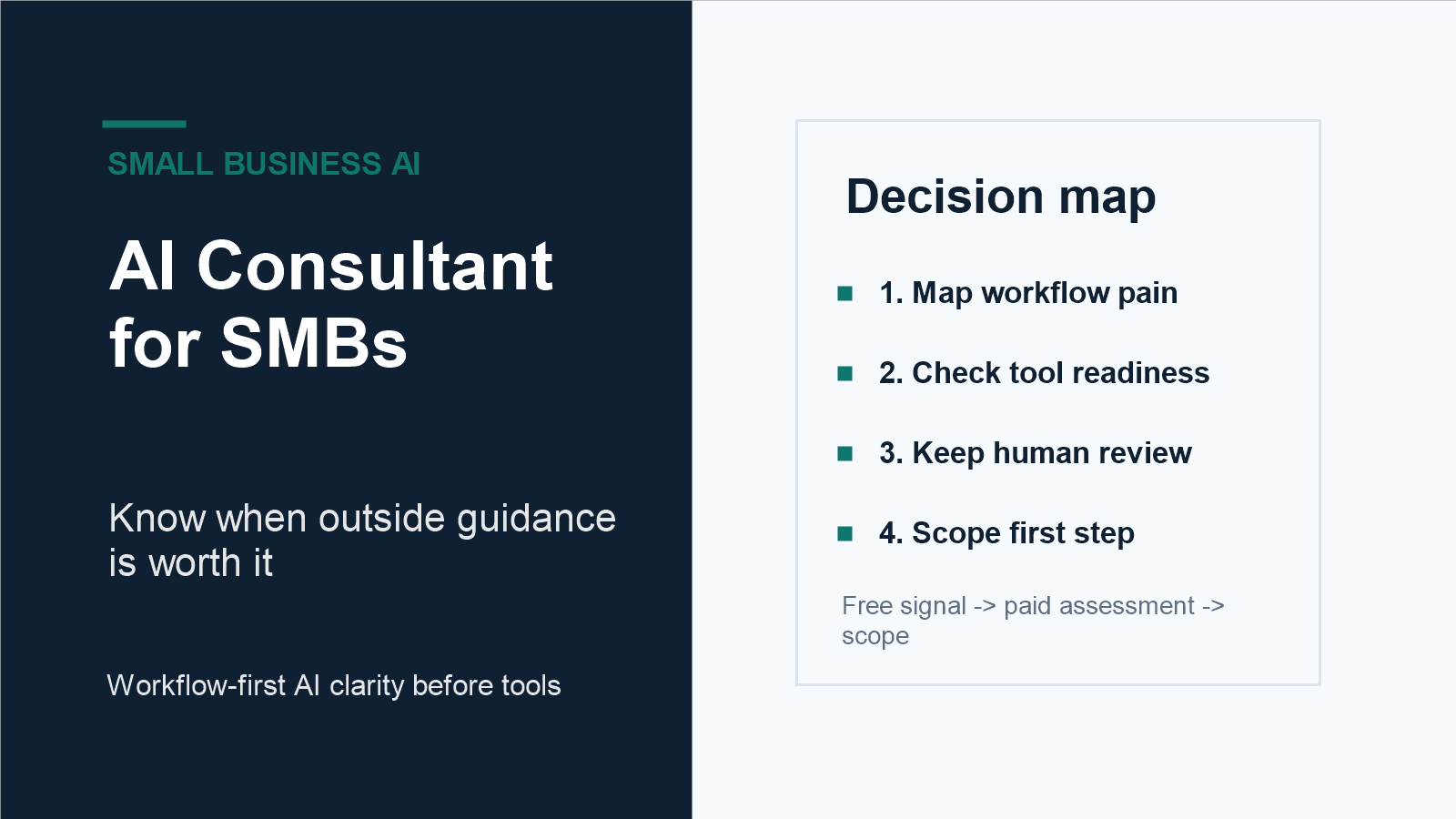
There is a lot of noise around AI consulting. Some of it is useful. Some of it is just tool demos, prompt packs, or big strategy language dressed up for small businesses that need something more practical.
If you run an SMB, the question is not "Should we hire an AI consultant?" The better question is: "Do we have a workflow problem that is important enough, repeated enough, and unclear enough that outside judgment would help?"
That is the point where an AI consultant can be useful.
You may need one when AI interest is scattered
Many small businesses are already using AI casually. Someone uses ChatGPT for emails. Someone tests a meeting summary tool. Marketing tries image generation. The owner asks AI to draft a job description. A sales person experiments with follow-up copy.
None of that is bad. But it does not automatically create a business system.
An AI consultant can help when the usage is scattered and the business needs a clearer answer:
- which workflow should we improve first?
- which current tools should stay?
- where should AI draft, summarize, classify, or prepare work?
- where should human approval remain?
- what should we avoid automating?
The value is not just AI knowledge. The value is decision structure.
You may need one when repeated work is costing attention
The best use cases usually start with ordinary friction:
- lead follow-up is inconsistent
- quotes or proposals depend too much on the owner
- customer replies take too long to prepare
- internal knowledge is scattered across documents and messages
- reports are built manually every week
- handoffs between sales, operations, and delivery lose context
These problems are not glamorous. That is why they are good. They are close to real work.
A good consultant should help you locate the bottleneck, estimate impact, check readiness, and define a small first version that the team can actually use.
You may not need one yet
Not every business should hire AI help immediately.
You may not need a consultant yet if:
- you are only curious and have no repeated workflow pain
- you want a general AI course, not a business-specific recommendation
- your current processes are too undefined to review
- you expect AI to fix people, management, or customer experience issues without changing the workflow
- you want guaranteed ROI before anyone has reviewed the actual work
In those cases, start smaller. Use a free assessment, map one repeated workflow, or write down where the team loses time before paying for deeper help.
What a small business AI consultant should not do
A consultant should not sell you a tool before understanding the workflow.
They should not promise that every business process can be automated. They should not treat human review as a failure. They should not turn a small business into a software experiment just because the technology is interesting.
And they should not give you a generic AI strategy deck that never becomes a practical decision.
Useful filter: if the consultant cannot explain what the first workflow should be, why it matters, and how the first version would stay under human review, the advice is probably too abstract.
What to expect from a practical consultant
A practical AI consultant for a small business should begin with questions about the work:
- Where does repeated work show up?
- Which tasks depend too much on the owner?
- What tools does the team already use?
- Where does context get lost?
- Which delays affect revenue or customer experience?
- Which outputs need human approval?
- What first workflow would be useful even if the company never builds a large AI program?
That is a different conversation from "Here are the latest AI tools." Tools can help, but only after the workflow is clear.
Assessment before implementation
For many SMBs, the first paid step should be an assessment, not a build.
That gives the business owner a clearer view before committing more money. A good assessment can show the workflow opportunities, compare impact and effort, define the first recommended workflow, and outline what implementation should include.
Then the owner can decide: build internally, hire implementation help, or wait until the workflow is cleaner.
That is a healthier buying decision than jumping straight into automation because everyone feels behind.
What should the first engagement cost?
For a small business, a first AI consulting engagement should be priced against the decision it helps make.
A short generic consultation may be cheap, but it may not give enough context. A large transformation project may be too much before the business knows what should be built. A fixed-scope assessment can sit in the useful middle: enough depth to make a decision, without pretending implementation has already been scoped.
The question is not whether AI consulting is expensive. The question is whether it prevents wasted tool spend, wrong builds, owner time, and months of vague experimentation.
If you want that first decision clearly mapped, the AI Workflow Assessment - $797 is built to identify the first AI workflow worth improving before implementation.
You can review the sample assessment first. If you are still early, take the free AI Workflow Assessment and get an initial signal.
The main point
You do not need an AI consultant to tell you AI is important. You need one if you want help turning AI interest into a practical workflow decision.
Start there. One business problem. One repeated workflow. One clear next step.
