

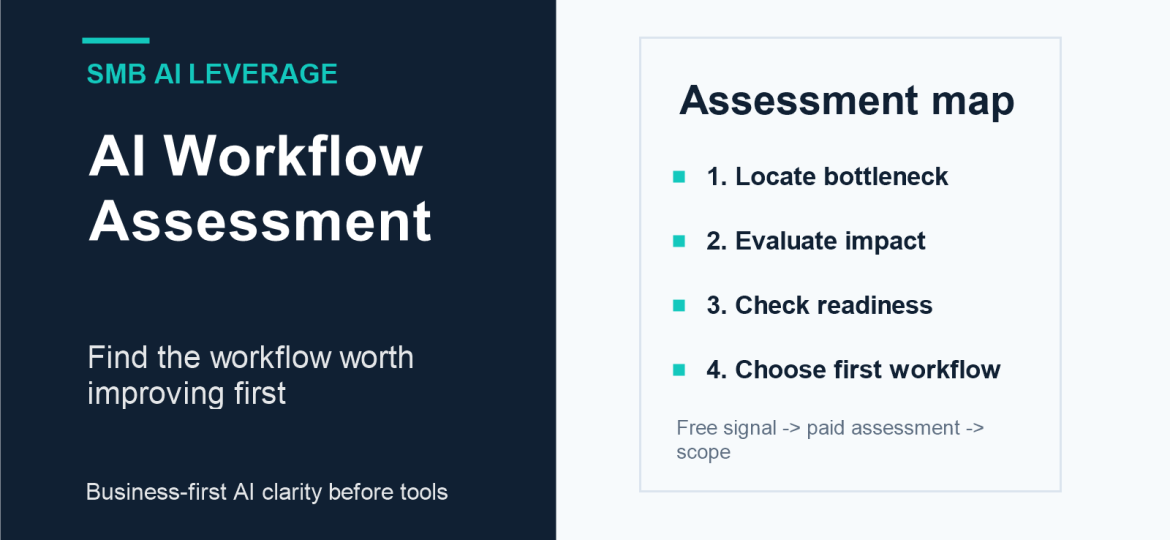
AI Workflow Assessment
What Is an AI Workflow Assessment?
An AI workflow assessment is a practical review of how work actually moves through a business. The goal is not to pick a shiny AI tool. The goal is to find the repeated workflow worth improving first.
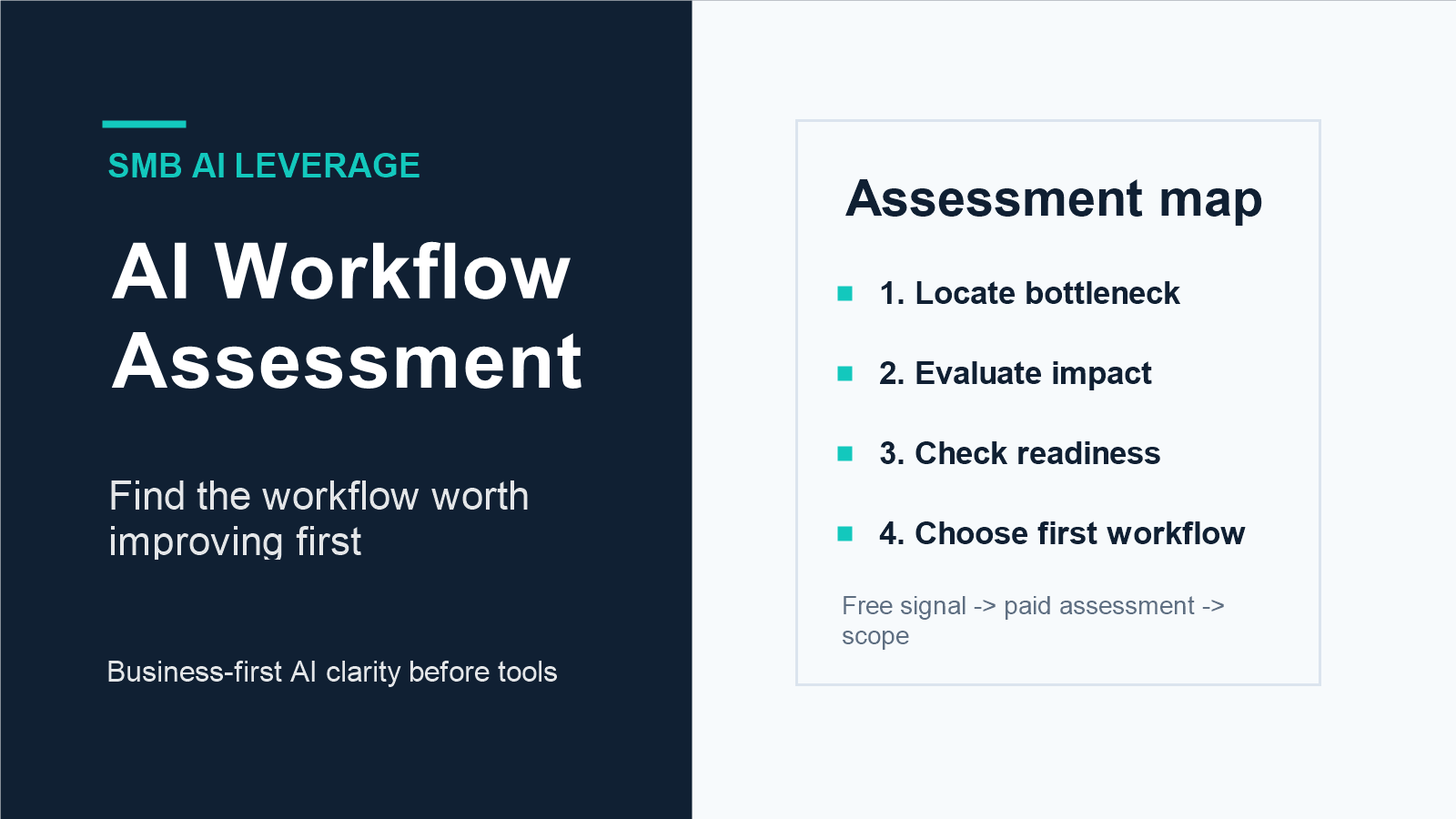
Most small businesses do not start with an AI strategy problem. They start with small pieces of work that keep coming back: quote follow-ups, customer replies, reporting, invoice checks, internal questions, scheduling, intake notes, handoffs, and updates that depend too much on one person.
That is why an AI workflow assessment is different from a generic AI consultation. It does not begin with "Which AI tool should we use?" It begins with "Where does repeated work slow the business down, and which of those workflows is structured enough to improve?"
If that question is answered well, the business can avoid two expensive mistakes: buying software before the workflow is clear, or building automation around a process that should have been simplified first.
What an AI workflow assessment should review
A good AI workflow assessment looks at the business before it looks at the technology. The review should cover the everyday work that creates delay, rework, owner dependency, or inconsistent follow-up.
In practical terms, that usually means reviewing:
- the business context and the type of work the team repeats every week
- current tools such as CRM, email, spreadsheets, project management software, accounting systems, or support platforms
- where information enters the business and where it gets lost
- which workflows sit close to revenue, customer experience, delivery, or operations
- which tasks can be drafted, summarized, classified, routed, checked, or prepared by AI
- where human review must stay in the process
- what should be improved first, what should wait, and what should not be automated
The word "workflow" matters here. A workflow has a trigger, inputs, steps, decisions, outputs, and a next action. If those pieces are not clear, an AI tool may make the work look more modern without making the business easier to run.
The assessment should produce a decision, not just ideas
The output should not be a random list of twenty AI use cases. That feels exciting for about ten minutes and then becomes another document nobody uses.
The useful output is a recommendation. For example: "Your best first AI workflow is inbound lead intake and follow-up, because it happens often, sits close to revenue, has clear source data, and can keep human review before anything is sent."
That kind of recommendation gives the owner something to do next. It also makes the implementation discussion more grounded. The business is not asking for "AI automation" in general. It is asking whether one specific workflow should be improved, and what the first version should look like.
Simple test: if an AI assessment cannot tell you what workflow to improve first, it is probably too abstract. A useful assessment should help the business make a practical next decision.
What an AI workflow assessment is not
An assessment is not an implementation project. It should not promise that AI will save a fixed number of hours or create guaranteed revenue. Results depend on the workflow, data quality, tool access, team adoption, and the quality of the build.
It is also not a generic tool comparison. Tool choice matters, but only after the business knows which workflow it is trying to improve. Otherwise the team can spend weeks comparing software while the real bottleneck stays untouched.
And it is not a replacement for human judgment. In many small businesses, the best AI workflows are reviewed workflows. AI can draft a reply, summarize a lead, prepare a checklist, or classify a request. A person still decides what should be sent, approved, changed, or escalated.
Who should consider one?
An AI workflow assessment is a good fit when the owner or leadership team already feels the pressure of AI but does not want to guess.
It is especially useful if:
- your team repeats the same admin, reporting, follow-up, or support tasks every week
- important work still depends on the owner remembering, interpreting, or chasing things
- you have business tools in place, but the handoffs between them are messy
- you are considering AI automation but are not sure what should be built first
- you want enough clarity to brief an internal IT person, automation specialist, or implementation partner
It may be too early if the business is only casually curious about AI and has no repeated workflow pain. In that case, a lower-friction first step is better.
How the free and paid steps should work together
A free assessment is useful for a first signal. It can help you notice the broad area where AI might create leverage: admin work, follow-up, reporting, customer replies, internal knowledge, or owner dependency.
A paid AI workflow assessment should go deeper. It should review your actual business context, tools, repeated work, bottlenecks, priorities, risks, implementation scope, and the first workflow worth improving.
That is the clean path: first signal, then deeper assessment, then implementation only when the workflow is clear.
Want the deeper version? The AI Workflow Assessment - $797 includes structured intake, human review, a 15-20 page report, implementation scope, and a video walkthrough.
If you want to see the format first, review the sample AI Workflow Assessment. If you are still early, start with the free AI Workflow Assessment.
The main point
AI becomes practical when it is attached to a real workflow. The right assessment helps a business choose that workflow before it spends money on tools, consultants, or implementation.
Start with the repeated work. Find the bottleneck. Decide what should be improved first. Then build only when the workflow is clear enough to deserve it.
