


Accounting GEO
How to Structure an Accounting Firm Service Page for AI Search
A good accounting service page should not make a buyer, Google, ChatGPT, or Copilot guess what the firm actually does. It should name the service, explain fit, show proof, define the next step, and stay honest about limits.

Direct answer: what should an accounting firm service page include?
An accounting firm service page for AI search should include a clear service definition, the client type it fits, location or service-area detail, the business problem solved, process steps, required inputs, proof, credentials, FAQ, source-backed guidance, internal links, LocalBusiness or Organization details where appropriate, and a practical CTA. The goal is clarity for buyers first, and AI search second.
This is not about writing for machines. It is about removing ambiguity from a page that should already help a serious prospect make a decision.
If your page says "tax, bookkeeping, payroll and advisory services," it may be accurate, but it is not yet useful. A buyer wants to know whether you help their kind of business, with their kind of accounting problem, in their location or operating model, at the level of complexity they actually have.
AI search systems have a similar problem. They need public, crawlable, consistent sources they can use when a person asks a specific question. A page that explains the offer clearly is a better source than a page that only lists broad capabilities.
What the page must prove before AI search matters
Google's current guidance for generative AI features is useful because it lowers the temperature. There is no special markup or trick that guarantees visibility in AI Overviews or AI Mode. Google says normal SEO foundations still matter: useful content, crawlable pages, technical clarity, high-quality images where helpful, and content that serves real users.
OpenAI's ChatGPT search help makes another practical point: ChatGPT can search the web and provide sources, but the experience depends on available information and cannot guarantee placement. Bing's AI Performance report also treats AI visibility as citation and grounding activity, not a ranking promise.
For an accounting firm, the conclusion is simple. Do not start with "How do we make ChatGPT recommend us?" Start with "Could a skeptical business owner understand this service page in two minutes?" If the answer is no, fix the page first.
This Day 27 article supports the broader guide on why ChatGPT may not mention your accounting firm. That article explains the visibility gap. This one gives the service-page structure to repair it.
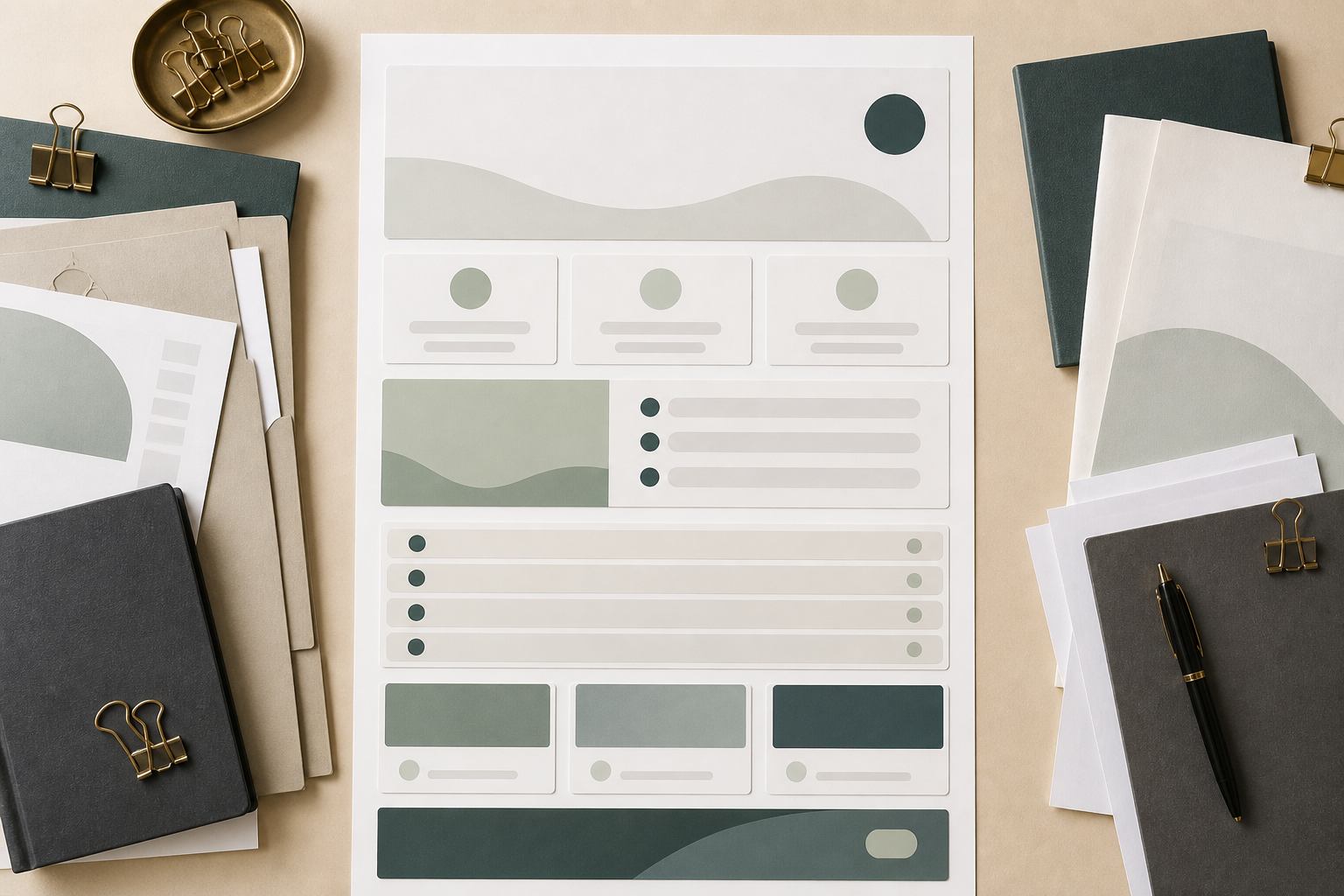
The service-page structure I would use
1. Lead with the specific accounting service
Use the title and first paragraph to name the service plainly. "Monthly bookkeeping for growing dental practices" is clearer than "business accounting solutions." "Tax planning for owner-led S corporations" is clearer than "tax services."
The first screen should answer four questions: what service is this, who is it for, what problem does it solve, and what should the visitor do next?
2. Explain who the service is not for
This feels uncomfortable, but it builds trust. A firm that specializes in advisory for construction companies may not be the right fit for one-off individual tax filing. Say that politely. Clear limits help buyers self-select, and they help public sources describe the firm more accurately.
3. Add location and service-area clarity
Google Business Profile guidelines emphasize accurate real-world business information, including the business name, category, address or service area, website, phone, and business description. Even if your firm works remotely, location still matters for many accounting searches because licensing, state tax rules, local reputation, and buyer trust can be location-sensitive.
Do not stuff city names into a title. Explain the real service model: local office, remote-only, state-specific, regional, niche industry, or national advisory.

4. Describe the process in business language
A buyer should see what happens before and after the first call. For example: review current books, identify cleanup issues, map monthly close tasks, define reporting needs, agree on ownership, then decide whether advisory support makes sense.
This is where many accounting pages are too thin. They list outcomes like "better financial insight" but skip the work that creates the outcome. Specific process language is useful for prospects and easier for AI search tools to summarize without inventing details.
5. Show proof without exposing client data
Accounting firms handle sensitive information. Proof should be specific but careful: industries served, anonymized scenarios, credentials, review themes, years of practical experience, partner platforms, public speaking, practical guides, and examples of decisions the firm helps clients make.
The IRS reminds taxpayers to understand preparer credentials and qualifications. If credentials matter to the service, make them visible and accurate. Do not bury important qualifications in a footer or a team page that the service page never connects to.
6. Add FAQ that answers real buyer hesitation
Useful accounting FAQs do not repeat sales copy. They answer questions like: what records are needed, who handles cleanup, whether the firm serves a specific state or industry, how advisory differs from bookkeeping, and when a client should not hire the firm yet.
7. Use structured data as support, not a shortcut
Google's LocalBusiness structured data documentation is helpful for describing local business details, but it should support visible content. If the page says one thing and your schema says another, the page has a trust problem, not a markup problem.
Accounting service-page checklist
Use this checklist on one priority page before publishing new supporting articles.
Page clarity audit
- Does the H1 name the specific service, not only the firm category?
- Does the first screen say who the service fits and what problem it solves?
- Does the page state location, service area, remote model, or state-specific limits honestly?
- Does the page explain the process in plain business language?
- Does it list the records, access, or inputs a client needs to provide?
- Does it show proof: credentials, review themes, anonymized examples, industries, or public sources?
- Does it link to a broader source page, such as a guide, FAQ, or firm profile?
- Does it avoid promises that the firm cannot safely or ethically guarantee?
- Does FAQ answer real buying friction, not generic marketing questions?
- Does the page CTA match the service stage: assessment, consultation, audit, or intake?

Decision table: which section should you improve first?
| Page problem | What it causes | First improvement |
|---|---|---|
| The page lists every accounting service in one paragraph. | Buyers and AI search tools cannot tell which service the page should own. | Create a focused service page for the highest-value buyer problem. |
| The firm serves remote clients, but the page gives no geography. | Local, state, and service-area questions become harder to match. | Explain the real service model and align public profiles. |
| The page says "trusted experts" but shows no evidence. | The claim feels generic and is hard to cite. | Add credentials, process detail, review themes, and anonymized examples. |
| FAQ only answers "Why choose us?" style questions. | The page misses practical buyer hesitation. | Add questions about records, timelines, cleanup, advisory scope, and fit. |
| Schema describes details that are not visible on the page. | The public source of truth is inconsistent. | Fix visible content first, then align structured data. |
A concrete SMB example
Imagine a five-person accounting firm in North Carolina that wants more monthly advisory clients from home-service companies. The current service page says the firm offers bookkeeping, payroll, tax planning, and advisory. It has a contact button, a few general paragraphs, and a team photo.
The firm is experienced, but the page is not doing enough work. A better page would lead with "Monthly bookkeeping and advisory for home-service businesses in North Carolina." It would explain common problems: messy job costing, delayed invoices, payroll timing, cash-flow surprises, and unclear monthly reporting. It would describe the first review, the records needed, what gets cleaned up, what stays with the client, and when tax planning enters the conversation.
It would also connect proof. The page could mention the firm's CPA credentials, years serving service businesses, review themes around responsiveness, anonymized examples of reporting cleanup, and a clear process for protecting client information. Then it would link to related resources, including the business entity consistency audit, the broader guide on making a website citeable by AI search engines, and the practical GEO guide for small business owners.
That does not guarantee a mention in ChatGPT. It does make the firm easier to understand and compare. That is the better target.

Mistakes to avoid
Do not build near-duplicate service pages
Google warns against creating pages mainly for every possible query variation. For accounting firms, that means avoiding dozens of thin city, industry, or service-name variants. Build fewer pages that answer real buyer questions well.
Do not make AI search claims you cannot measure
Do not promise rankings, AI citations, or ChatGPT recommendations. Track Search Console, prompt tests, Bing AI Performance where available, and inquiry quality separately. Treat the data as signals, not proof of causation.
Do not hide the service behind firm-first copy
Prospects do care who you are, but the service page should start with their problem. Firm story and credentials matter more after the visitor understands fit.
Do not ignore public profile consistency
If Google Business Profile, directories, LinkedIn, review platforms, and the website describe different services, AI search systems may not know which version is current. Buyers may not know either.
Do not expose private client detail as proof
Use anonymized examples and process detail. Accounting trust depends on discretion. Specificity should make the page more useful, not less safe.
Check whether AI search can understand your service pages
A practical audit should review the page structure, public profiles, proof, local signals, FAQ, schema, and repeatable AI-search tests before recommending more content.
Sources
- Google Search Central: Optimizing for generative AI features on Google SearchUsed for current Google guidance on useful content, crawlability, avoiding query-variation pages, and measurement.
- Google Business Profile Help: Guidelines for representing your business on GoogleUsed for real-world business name, category, address, service-area, website, phone, and description consistency.
- Google Search Central: LocalBusiness structured dataUsed for structured-data context that should align with visible local business details.
- OpenAI Help Center: Searching the web with ChatGPTUsed for current ChatGPT search and source behavior.
- IRS: Understanding tax return preparer credentials and qualificationsUsed for accounting credential and representation-rights context.
- Bing Webmaster Tools: AI PerformanceUsed for citation and grounding-query measurement concepts.
FAQ
Can a better accounting service page make ChatGPT recommend my firm?
It can improve clarity and source quality, but it cannot force a recommendation. The practical goal is to make the firm easier to understand, compare, and cite for relevant buyer questions.
Should an accounting firm create a separate page for every city or service?
No. Create a separate page only when the intent, service, geography, and buyer need are genuinely distinct. Thin location or keyword variants can confuse users and weaken trust.
What is the most important section on an accounting service page?
The first screen matters most because it sets the service, client fit, problem, and next step. Proof, process, FAQ, and internal links then support that promise.
Does LocalBusiness schema help accounting firm AI search visibility?
It can support clearer business information, but it is not a shortcut. The visible page, Google Business Profile, public profiles, and structured data should all describe the same real business.
How should accounting firms prove expertise without exposing client data?
Use credentials, process detail, industries served, anonymized scenarios, review themes, partner platforms, and practical explanations. Do not publish private client facts or invented results.
How should we test whether the page works for AI search?
Use a repeatable prompt set based on real buyer questions. Track whether the firm is mentioned, cited, described accurately, confused with another firm, or skipped, then compare that with Search Console and inquiry quality.
