


AI business assessment
AI Business Assessment vs AI Readiness Checklist: What Is the Difference?
An AI Readiness Checklist helps you spot whether your business may be ready for AI automation. A Full AI Business Assessment helps you decide what to automate first, what to fix before implementation, which risks matter, and what a sensible pilot should look like. They are connected, but they are not the same tool.

The simple difference
Most small business owners do not wake up thinking, "I need an AI business assessment." They usually think something much more practical: "We are spending too much time on follow-ups," "I do not know which AI tool to choose," or "My team tried ChatGPT, but nothing really changed."
That is why the distinction matters. A checklist is a first filter. It helps you see whether there are obvious time leaks, data gaps, repeated tasks, or risk areas worth discussing. A Full AI Business Assessment is a deeper working session. It turns those early signals into a decision about workflows, ownership, data readiness, tool fit, risk control, and a first pilot.
If you are still exploring, start with the free AI assessment. If you are close to spending money, connecting systems, or asking your team to change how work gets done, use the Full AI Business Assessment.
My rule is simple: use the checklist to find the question. Use the assessment to make the business decision.
What an AI Readiness Checklist is for
An AI Readiness Checklist is useful when the business needs clarity, but the decision is still early. It should not pretend to produce a complete AI strategy. It should help you notice patterns.
For example, a checklist can ask whether the team repeats the same customer replies, whether lead follow-ups are slipping, whether reports are built manually every week, whether SOPs are current, whether customer data is scattered, and whether anyone owns the workflow after a tool is introduced.
That makes the AI Readiness Checklist a good first step for business owners who know AI matters but do not yet know where to start. It gives language to the problem without turning the first conversation into a large project.
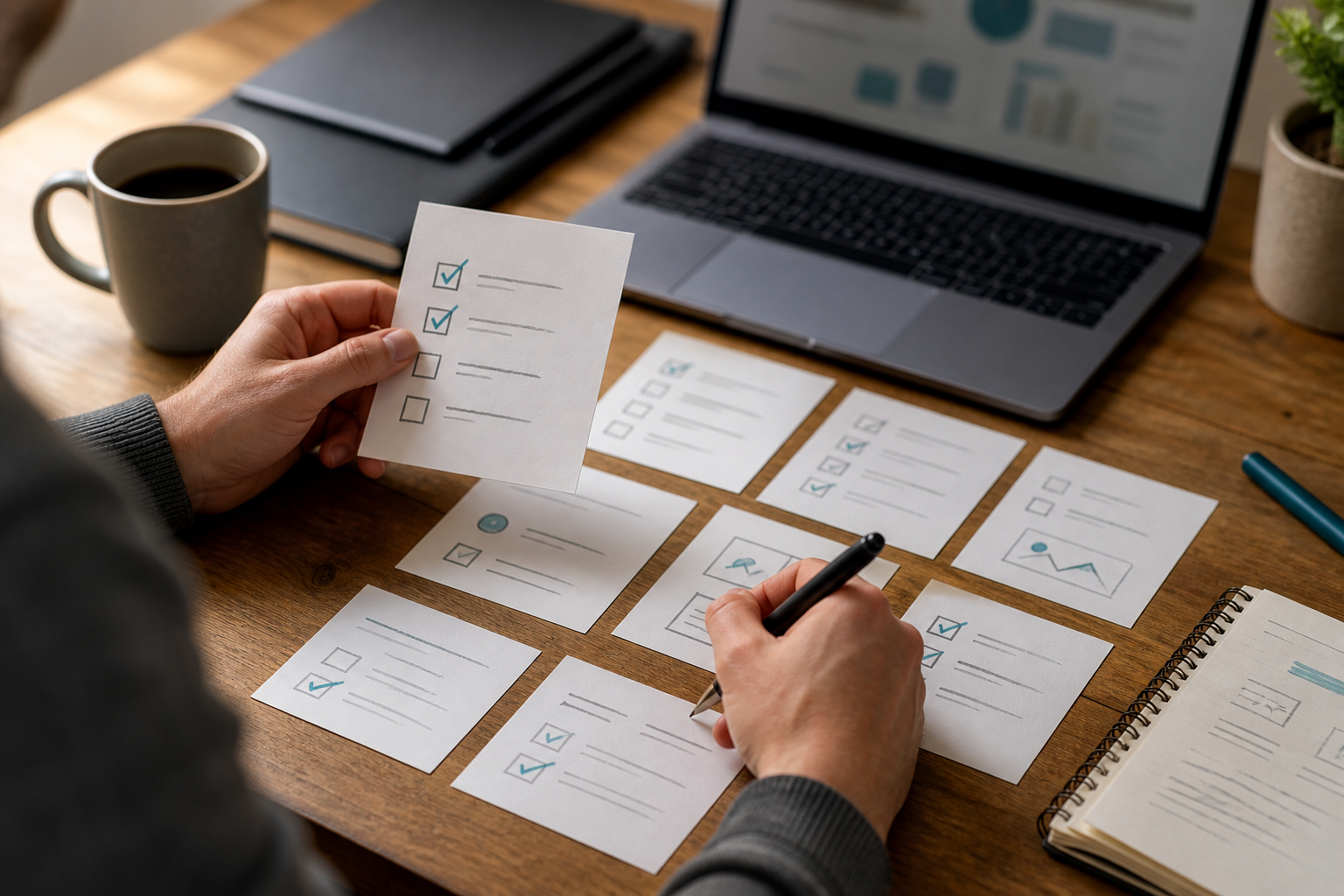
Where a checklist helps
- You want to identify obvious time leaks before booking a deeper session.
- You need to compare several possible workflows at a high level.
- You are not yet ready to choose a tool, budget, owner, or build plan.
- You want a low-pressure way to involve the owner or leadership team.
- You need to see whether your current data and processes are too messy for automation.
The best checklist is practical. It should not ask abstract maturity questions that sound impressive but do not change what you do next. It should point to real work: emails, quotes, invoices, reports, intake forms, support tickets, internal knowledge, and approval steps.
What a Full AI Business Assessment is for
A Full AI Business Assessment goes beyond readiness signals. It looks at how the business actually works today and where AI could create useful leverage without creating avoidable risk.
That means mapping workflows, checking source data, reviewing tool options, finding human approval points, estimating business value, and choosing a controlled first pilot. It is closer to a business review than a technology demo.
This is the same principle behind the AI automation consultant for small business pillar guide: do not start with tools. Start with the repeated work that is costing time, quality, speed, or attention.

What the assessment should answer
- Which workflow is the strongest first AI automation candidate?
- What source data, examples, templates, or SOPs support that workflow?
- Where should AI draft, summarize, classify, extract, search, or prepare work?
- Where must a person still review, approve, or correct the output?
- Which tools or integrations fit the scope without overbuilding?
- What would make the first pilot worth continuing after the first month?
If you want the step-by-step version, I wrote a separate guide on what happens during a Full AI Business Assessment.
Side-by-side comparison
The easiest way to decide is to compare the job of each tool. A checklist is not a weaker assessment. It simply answers a smaller question.
| Question | AI Readiness Checklist | Full AI Business Assessment |
|---|---|---|
| Main purpose | Find likely AI opportunities and readiness gaps. | Choose the right workflow, plan the pilot, and reduce avoidable risk. |
| Best timing | Early exploration. | Before implementation spend or tool selection. |
| Depth | Light diagnostic. | Workflow, data, risk, ownership, tool fit, and roadmap review. |
| Output | Priority signals and suggested next step. | A practical decision document and first pilot direction. |
| Risk review | Basic warning signs. | Specific human review points, permissions, data exposure, and operating rules. |
| Business value | High-level opportunity estimate. | Specific value case tied to time, speed, quality, risk, or revenue impact. |
When the checklist is enough
A checklist may be enough when the business is still learning where AI might fit. You may not need a full assessment if the workflow is simple, low-risk, and still only a rough idea.
For example, suppose your team spends time rewriting meeting notes into follow-up emails. You are not connecting customer databases yet. You are not approving payments. You are not letting AI send anything automatically. In that case, a checklist plus a small internal experiment may be enough to learn whether the workflow deserves more attention.
The checklist is also useful when leadership is not aligned. One person may think AI should help marketing. Another may care about reporting. Another may worry about customer replies. A simple readiness review gives everyone the same starting language before the conversation becomes technical.
The article on the AI Readiness Score can help if you want to score one candidate workflow before deciding whether it is ready for a deeper review.
When the assessment is the better move
A Full AI Business Assessment becomes the better move when the decision has real consequences. That usually means money, customer trust, team adoption, private data, operations, or a workflow that touches several systems.
This is where many businesses get into trouble. They buy a tool because the demo looks good, then discover that the real workflow has exceptions, missing data, unclear approvals, or nobody responsible for maintaining the process after launch.
NIST's AI Risk Management Framework is helpful here because it encourages organizations to govern, map, measure, and manage AI risk. In SMB language, that means you should know what the workflow is for, what can go wrong, how you will test it, and who owns it after launch.

Use the assessment when:
- you are about to choose a tool or implementation partner;
- the workflow touches customer data, finance, HR, contracts, or approvals;
- several systems need to work together;
- you need team adoption, not just a clever prototype;
- you want a roadmap before committing to a build;
- the first AI project has to prove value quickly because trust is limited.
This does not mean every business needs a large AI project. Often the assessment finds a smaller first pilot than the owner expected. That is a good outcome if it prevents waste.
Three practical examples
Example 1: lead follow-up
A checklist may reveal that new leads are not followed up consistently. That is useful. But if you want AI to score leads, draft replies, update CRM fields, and trigger reminders, you need a fuller assessment. The business has to decide what data can be used, what the sales team still approves, and how success will be measured.
Example 2: internal knowledge search
A checklist can show that one senior person answers the same questions every week. A full assessment checks whether the source material is current, whether the team uses the same language, which documents should be included, and which answers need human review before they are trusted.
Example 3: weekly reporting
A checklist can confirm that reporting is a time leak. A full assessment reviews where the numbers come from, which metrics matter, who checks the report, what commentary AI can safely draft, and what decisions the report supports. That is the difference between "AI can summarize data" and "this reporting workflow can be improved safely."
What to do next
Do not overcomplicate this. If your business is still asking, "Where could AI help first?", start with a checklist. If your business is asking, "Which workflow should we improve, what will it cost, and how do we avoid building the wrong thing?", book the assessment.
Good AI work does not begin with a model name. It begins with a clear business decision. What work repeats? What is the current cost? What source material exists? What can go wrong? Who reviews the output? What would make the first pilot worth keeping?
When that decision is clear, the small business AI automation roadmap is the next step. It turns the assessment decision into a practical 30, 60, and 90 day plan for mapping, piloting, and measuring the first workflow.
Google's people-first content guidance is written for publishing, but the principle fits AI automation too: the work should help the intended audience achieve a real goal. For a business owner, that goal is not "use AI." It is to make a better operational decision with less guesswork.

Choose the right next step
If you are early, take the free assessment and identify the likely time leaks. If you are close to implementation, the Full AI Business Assessment will review workflows, data readiness, risk, ownership, tool fit, and the safest first pilot.
Sources reviewed
- NIST AI Risk Management FrameworkRisk management context for AI systems and organizational use.
- NIST AI RMF PlaybookPractical govern, map, measure, and manage framing for AI risk work.
- OECD AI PrinciplesTrustworthy AI principles, including human-centered values and accountability.
- European Commission: AI Act regulatory frameworkRisk-based AI regulation context, including transparency and human oversight themes.
- Google Search Central: creating helpful, reliable, people-first contentUseful standard for making practical content that answers a real user need.
- Google Search Central: AI-generated content guidanceSearch guidance on useful, high-quality content regardless of production method.
FAQ
What is the difference between an AI Business Assessment and an AI Readiness Checklist?
An AI Readiness Checklist is a light first filter that helps a business spot likely opportunities and gaps. A Full AI Business Assessment is a deeper review of workflows, data, risk, ownership, tool fit, and the first AI automation pilot.
Should I take the checklist before booking a Full AI Business Assessment?
Yes, if you are still early. The checklist helps you identify likely time leaks and readiness gaps. If you already know the business is close to choosing a workflow, tool, partner, or budget, the Full AI Business Assessment is the more useful step.
Does a checklist tell me which AI tool to buy?
No. A good checklist may show whether a workflow is worth exploring, but tool selection should come after the workflow, data, risk, ownership, and human review points are clear.
When is a Full AI Business Assessment worth it?
It is worth it when the AI decision affects implementation spend, customer data, finance, HR, approvals, several systems, or team adoption. In those cases, the business needs a clearer pilot plan before building or buying.
Can a small business start with AI without a full assessment?
Yes. For a simple, low-risk workflow, a checklist and small controlled experiment may be enough. A full assessment becomes more useful when the workflow is important, connected to other systems, or risky enough to need clearer rules.
