

Free AI Visibility Checker · Generative Engine Optimization (GEO)
Free AI Visibility Checker:
Check your website’s GEO readiness.
Check the public website signals that help search and AI systems understand your business. Get a readiness score, two weak signal groups and one practical first action. This diagnostic does not measure every AI answer or guarantee rankings, recommendations or sales.
- See your GEO Readiness Score directly on screen
- Find the two signal groups holding your visibility back
- Get one practical first action without giving us website access
No credit card. No payment. No website login. Your free assessment is delivered by email and includes newsletter signup.
Free · automated · usually 1–3 minutes
Check what AI search can see.
Enter your company, website and email. Accept the clearly stated newsletter subscription, then receive your score, saved assessment and practical next steps. No card and no payment.
Why trust the person behind this assessment?
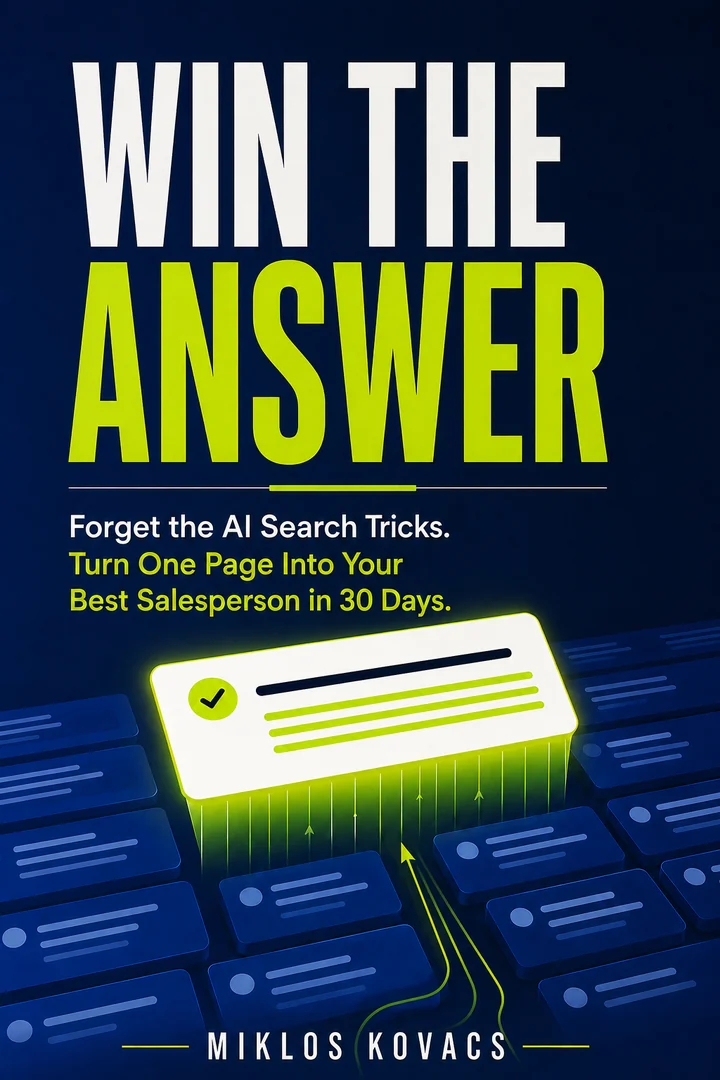
The method is also published on Amazon.
WIN THE ANSWER: Forget the AI Search Tricks. Turn One Page Into Your Best Salesperson in 30 Days. walks business owners through rebuilding the single revenue page that matters most. Its four-layer method—findable, understandable, citeable, and trustworthy—is the same practical foundation behind this assessment.
The book does not make the automated score a human review, and it does not guarantee AI citations. It does show that this free assessment comes from a documented, evidence-led body of work—not a generic lead form built around an unexplained number.
The definition, in plain English
What is Generative Engine Optimization (GEO)?
Generative Engine Optimization (GEO) is the practice of making public website information easy for generative search and answer systems to discover, understand, verify, and cite accurately. It combines crawl access, clear business entities, answer-ready content, supporting evidence, structured data, and consistent ownership signals. GEO complements SEO; it does not replace it.
You may also see related phrases such as AI search optimization, answer engine optimization (AEO), AI visibility checking, or LLM SEO. The labels vary; the business question is the same: can an answer system confidently use your website?
Important pages can be crawled, indexed, and discovered.
Your business, audience, services, and answers are explicit.
Claims have authorship, evidence, sources, and consistent entities.
A buyer can confirm the fit and take a sensible next step.
Two connected disciplines
GEO vs SEO: what is the difference?
SEO helps pages qualify for traditional search results, earn impressions, and attract clicks. Generative Engine Optimization (GEO) asks an additional question: can an AI system correctly interpret and use the page inside a generated answer? Both depend on crawlability, useful content, authority, and a website buyers can trust.
Visibility in search results and relevant visits.
Accurate mentions, citations, and source visibility in generated answers.
Indexing, rankings, impressions, clicks, and conversions.
Answer coverage, cited pages, mentions, accuracy, referrals, and conversions.
Technical access, people-first content, internal links, reputation, and authority.
The same foundations plus explicit entities, direct answers, evidence, and citeable context.
Google’s official generative-AI search guidance confirms that foundational SEO practices remain relevant to AI Overviews and AI Mode. No special markup or third-party score guarantees inclusion.
Turn a vague concern into evidence
How do you check if AI can see your website?
Use an AI visibility checker to inspect the public signals answer systems depend on: HTTP access, robots rules, sitemaps, readable pages, business identity, direct answers, evidence, authorship, and structured data. A useful audit also reports coverage and limitations, so an unverified check is never disguised as a confirmed failure.
A weighted readiness model
What does a GEO readiness score measure?
A GEO readiness score measures observable website conditions that make reliable AI discovery and citation more plausible; it does not measure a hidden ChatGPT ranking. This assessment combines eight weighted categories, shows how much of the planned scan completed, and identifies the weakest verified signals plus one practical first improvement.
Crawl access
Page delivery, noindex status, and priority crawler rules.
15% weightSite discovery
Sitemap availability and representative internal pages.
10% weightEntity clarity
Business identity, offer, audience, location, and contact paths.
15% weightAnswer-ready content
Question-led headings, direct answers, useful depth, and FAQ patterns.
15% weightEvidence quality
Named sources, examples, results, proof, and external references.
15% weightOwnership trust
Responsible people, organizations, authorship, and contact signals.
10% weightStructured data
Visible facts matched by relevant Organization, Person, and Service schema.
10% weightFreshness & measurement
Canonical and metadata coverage plus a measurable baseline.
10% weightOriginal data · 2026 pilot benchmark
What did our first cross-site GEO scan find?
We ran the same deterministic rule set across 17 public service-business websites in Ireland, United Kingdom, and United States. The figures below are aggregate observations from that defined sample—not invented market statistics and not population-wide estimates.
Pilot run date: 2026-08-28. Convenience sample drawn from public business research; aggregate results only. Each site was scanned once, up to seven pages were reviewed, inaccessible checks remain unverified, and no result implies traffic or citation causation.
Evidence you can inspect
See the method and the deliverable before you trust the score.
There is no fabricated testimonial here. Instead, you can inspect a crawlable worked example and the exact scoring model behind the assessment.
Open a complete sample GEO report
The fictionalized example shows an executive summary, eight category scores, evidence notes, five ranked priorities, page-specific recommendations, a 30-day action plan, and measurement guidance. It demonstrates the format without pretending a made-up company is a customer.
Audit the audit
The public methodology explains the URLs checked, category weights, scoring thresholds, coverage calculation, crawler interpretation, version number, and important limitations. You can see exactly what the number means—and what it cannot prove.
How it works
Three steps. No website access required.
Enter your details
Add your company, public website URL and email, then accept the newsletter subscription. The checkbox starts empty, so the exchange is always clear.
Watch the scan progress
The tool reports when it checks access, robots rules, sitemaps, representative pages, content, evidence, and schema.
Keep your first action
Your score, coverage, two weakest categories and quick win appear on screen and arrive by email, giving you a practical place to start.

Built for business decisions
Clear evidence before more tactics.
Miklos Kovacs approaches AI visibility as a practical business discipline: make the company easy to find, understand, and verify before investing in another content push or technical tool.
- The score comes from published rules, not an invented “ChatGPT ranking.”
- Coverage is shown so inaccessible checks are not disguised as failures.
- The free result is automated and is not presented as human consulting.
- No score can guarantee rankings, citations, recommendations, traffic, leads, or revenue.
Questions before you start
Straight answers. No AI-search hype.
The tool measures readiness signals from public pages. It gives you a baseline and a first decision—not a promise about what a third-party system will do.
Is the AI visibility checker really free?
Yes. There is no payment, credit card or website login. You provide an email and accept the newsletter subscription in exchange for the score, saved assessment and practical next steps. You can unsubscribe at any time.
Do I have to provide an email address?
Yes. The free assessment is delivered to the business email you enter, so you can keep your result and act on the next step instead of losing it after closing the page.
Does the free assessment include newsletter signup?
Yes. The single consent checkbox starts unchecked and clearly states that requesting the free assessment also subscribes you to practical GEO and AI visibility emails. You can unsubscribe from every newsletter message.
Does the assessment change my website?
No. It reads publicly accessible pages and produces a result. It does not log in, edit files, change settings, or install anything.
How long does the assessment take?
Most scans finish within one to three minutes. The form shows which stage is being reviewed. If the target website responds slowly, the scan stops after three minutes instead of leaving the form waiting indefinitely.
Is a human expert reviewing the free result?
No. The free score is automated. The public sample report is illustrative, and manual review or implementation help is a separate service available by emailing hello@mikloskovacs.io.
Does a high score guarantee AI citations or traffic?
No. Search and answer systems select sources separately for each query. This readiness score cannot guarantee rankings, mentions, citations, recommendations, traffic, enquiries, or revenue.
Why keep FAQPage schema if Google removed FAQ rich results?
The visible questions are useful to people and machine readers even without a Google FAQ rich result. The JSON-LD describes the content accurately, but the page does not claim a rich-result entitlement or guarantee.
Nothing to buy. A blind spot to remove.
Find out whether AI search can understand your website.
If the foundation is strong, you get a useful baseline. If it is weak, you discover the first gap before spending more time and money in the wrong place.
No card · no payment · email delivery · newsletter included · public pages only